Polynomial equations are a fundamental concept in algebra, and finding their roots is crucial for solving various mathematical problems. The roots of a polynomial equation are the values of the variable that make the equation true. For instance, in the equation x^2 + 4x + 4 = 0, the root is x = -2 because (-2)^2 + 4(-2) + 4 = 0. Understanding how to find the roots of polynomials is essential for advanced mathematical studies and applications in fields like science, engineering, and economics.
To find the roots and multiplicity of given polynomials, one must first understand the basics of polynomial equations. This includes knowing how to factor polynomials, use the quadratic formula, and apply other algebraic techniques. The multiplicity of a root refers to how many times the root appears in the factorization of the polynomial. For example, in the polynomial (x – 1)^2 * (x + 2), the root x = 1 has a multiplicity of 2 because it appears twice in the factorization.
Edia AI Platform For Student Outcomes
Understanding Polynomial Roots
Understanding polynomial roots involves recognizing that roots can be real or complex numbers. Real roots are the values that can be found on the number line, whereas complex roots involve imaginary numbers and are often represented in pairs. The method for finding roots depends on the degree of the polynomial. For linear polynomials (degree 1), the root is simply the value that makes the equation true. For quadratic polynomials (degree 2), the quadratic formula can be used. Higher-degree polynomials may require more advanced techniques, such as synthetic division or the use of a calculator.
Edia AI Platform For Student Outcomes
Determining Multiplicity
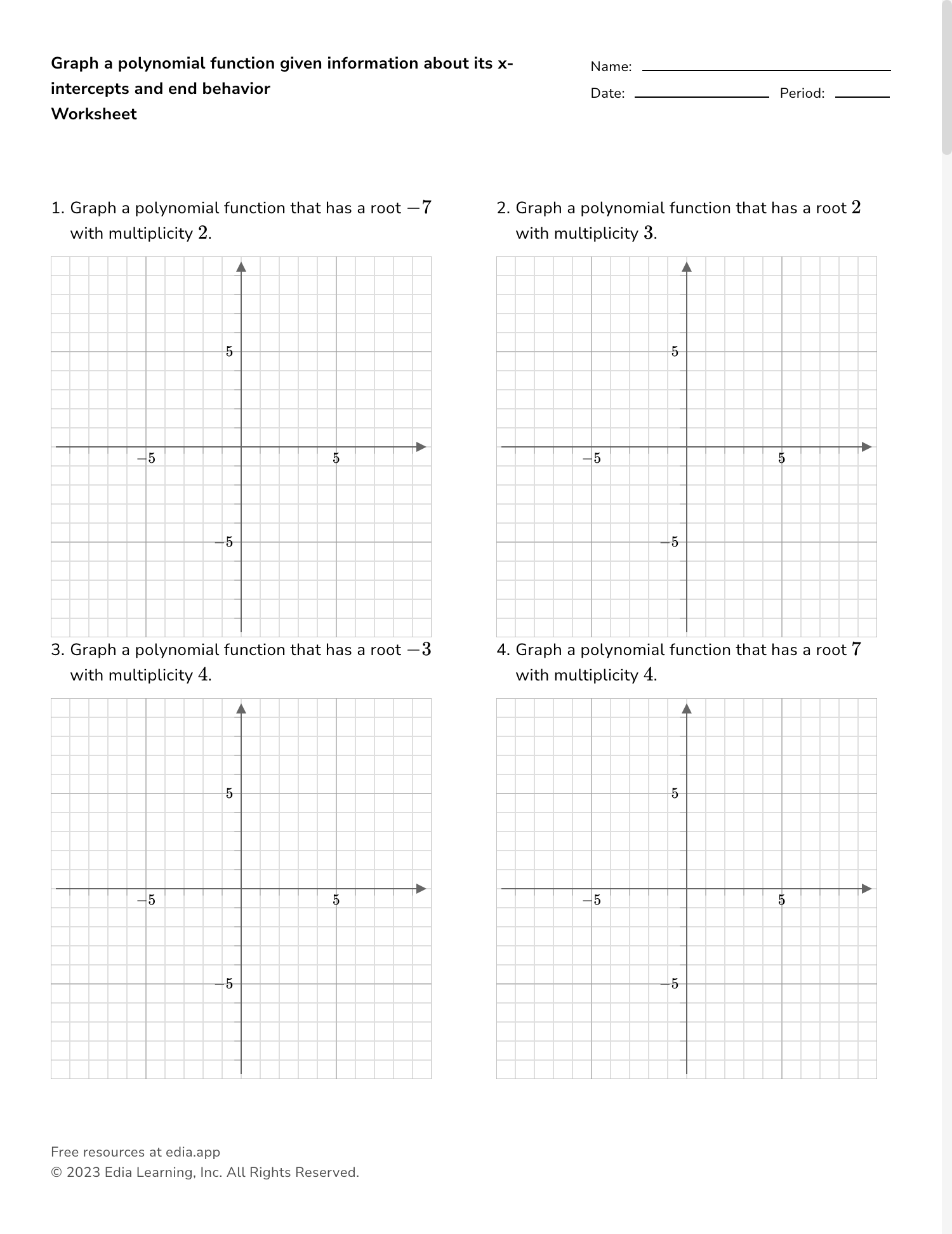
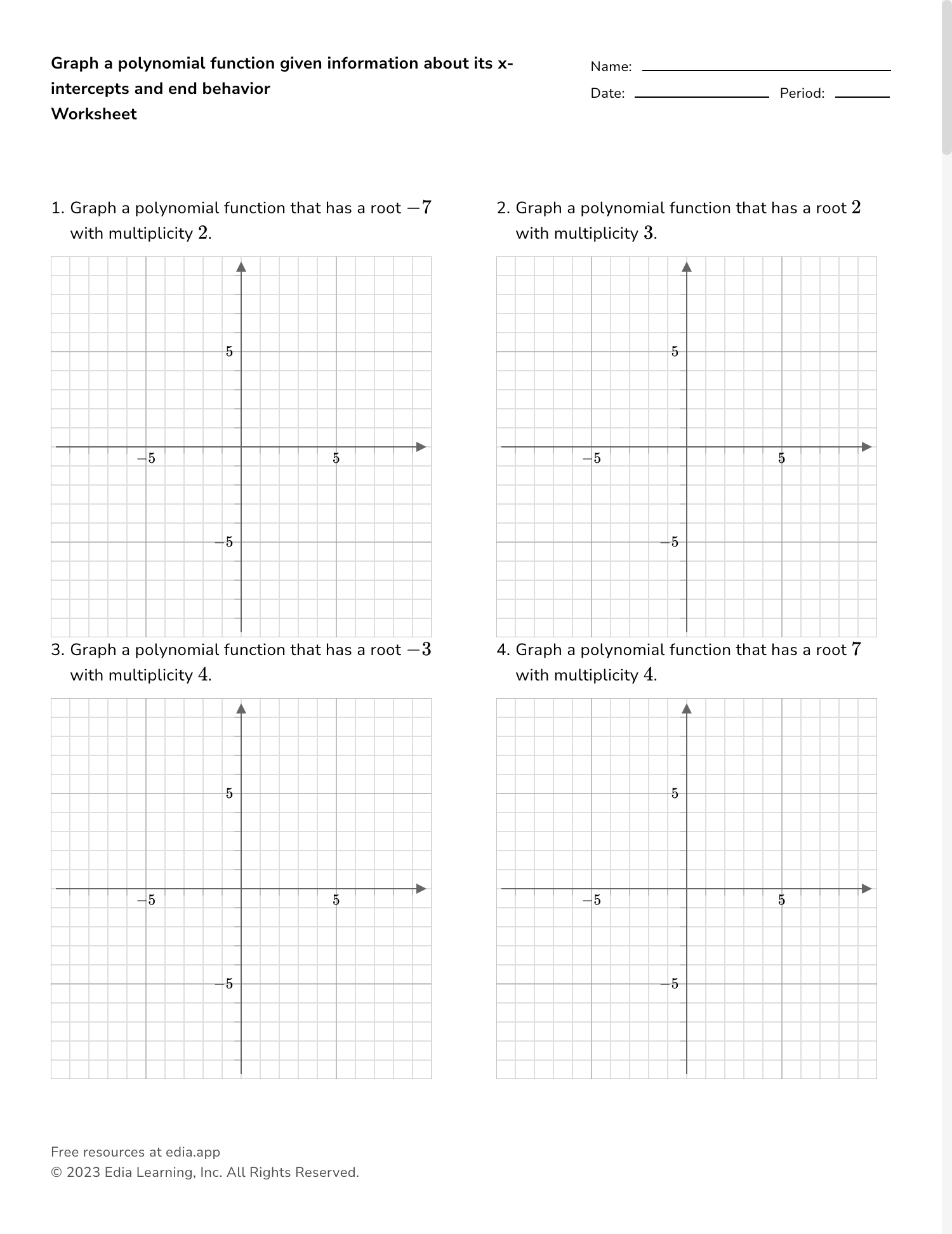
Determining the multiplicity of roots is crucial for understanding the behavior of polynomial functions. A root’s multiplicity affects the graph of the function, particularly at the points where the root occurs. If a root has an even multiplicity, the graph touches the x-axis at that point but does not cross it. If the multiplicity is odd, the graph crosses the x-axis. This understanding is vital for sketching the graphs of polynomial functions and analyzing their behavior.
Solving Polynomial Equations
Solving polynomial equations involves a combination of factoring, using the quadratic formula, and applying other algebraic methods. For higher-degree polynomials, techniques such as polynomial long division or synthetic division can be used to factorize the polynomial and find its roots. The Rational Root Theorem is another tool that helps in identifying potential rational roots of a polynomial. By systematically applying these methods, one can find the roots and their multiplicity, thereby solving the polynomial equation.
Edia AI Platform For Student Outcomes
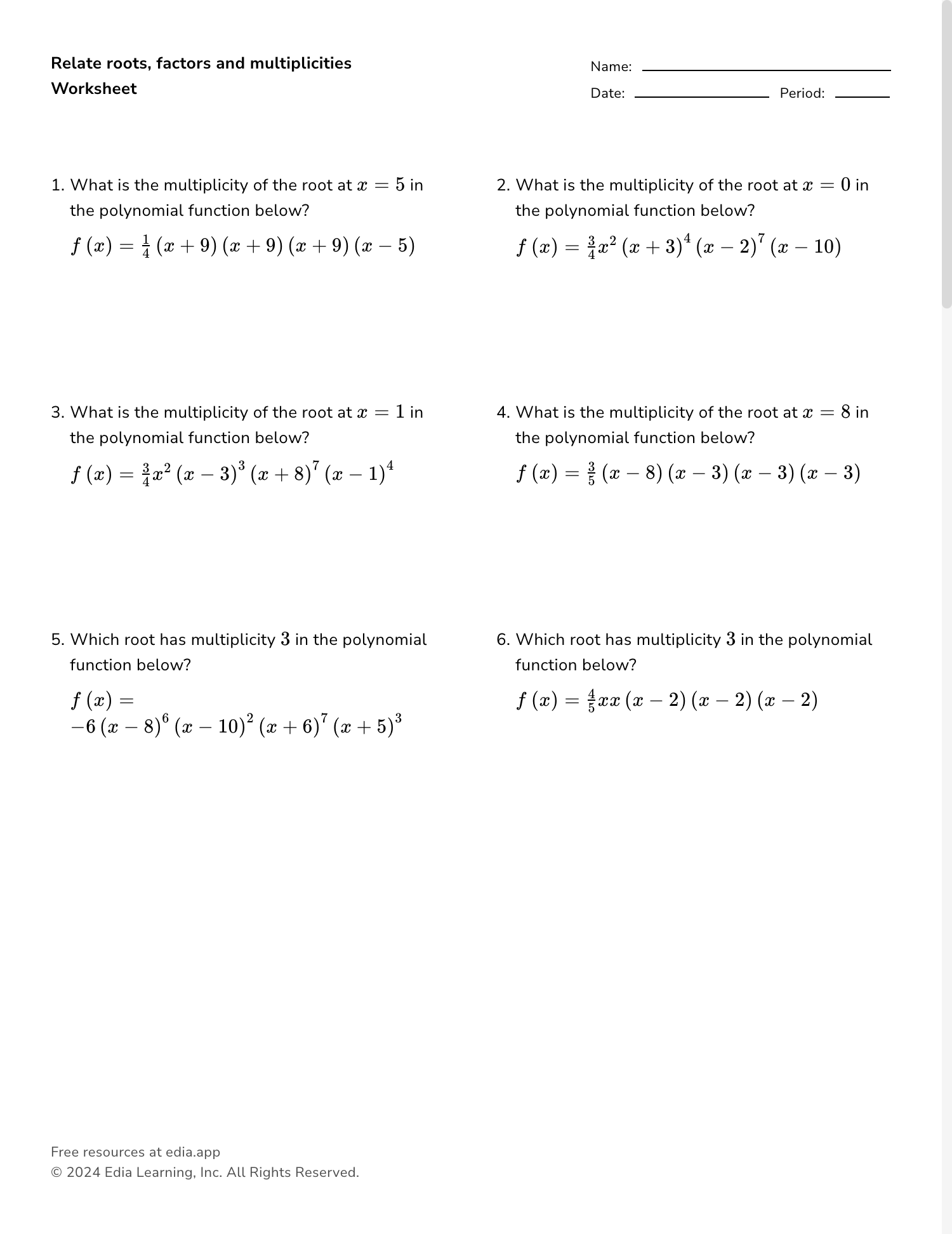
Practicing with worksheets and exercises is an effective way to master the skills required for finding the roots and multiplicity of polynomials. These resources provide a variety of polynomial equations to solve, helping learners to become proficient in different methods and techniques. Additionally, online calculators and software can aid in verifying solutions and exploring the properties of polynomial functions. By combining theoretical understanding with practical exercise, learners can develop a strong foundation in polynomial algebra.
Edia AI Platform For Student Outcomes
Edia AI Platform For Student Outcomes